


How to Prevent Theft on Construction Sites in Australia (2026 Guide)
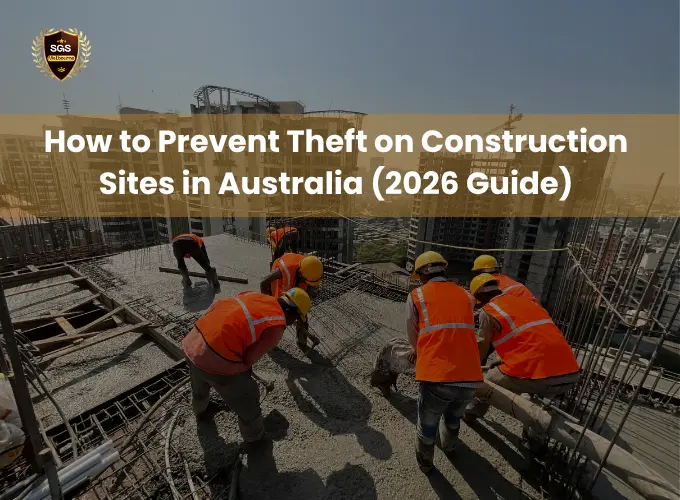
Construction sites often have multiple access points, expensive equipment, and long periods without supervision, making them easy targets for theft and vandalism.
This guide explains what is commonly stolen, how criminals gain access, and which security measures are proven to reduce risk. The recommendations are based on Victoria Police guidance, insurer data, and industry reports rather than assumptions.
Effective construction site security requires a layered approach. This includes secure perimeter fencing, controlled access, adequate lighting, locked overnight storage, CCTV, alarm systems, and, for larger or higher-risk projects, dedicated on-site security guards.
No single security measure can stop a determined intruder, but combining multiple layers of protection significantly reduces the risk of theft and unauthorized access.
Alarming!! Construction Site Theft Is Rising in Australia
Crime Statistics Agency Victoria data shows offences recorded at construction and under-construction locations reached 4,583 in 2025, up from 4,292 in 2024 and 4,187 in 2023. Theft was the single largest category within that total, followed by burglary and break-and-enter, with property damage a smaller but persistent third.
The pattern lines up with where Melbourne is actually building. The Victorian growth corridors with the highest recorded offences at construction sites include Wyndham, Melton, Casey, Hume, Whittlesea, and Greater Geelong — precisely the outer-metro areas seeing the most new residential and commercial development. More active sites simply mean more opportunity.
Victoria Police’s own construction-site theft guidance treats this as an ongoing prevention issue. Its recommendations include locking storage containers, installing CCTV and alarms, improving lighting, engraving and recording serial numbers on tools, and using guard services on higher-risk sites.
What Gets Stolen Most Often in Construction Sites
Power tools, copper wiring, fuel, machinery components, and near-completion fixtures are the most commonly targeted items on Australian construction sites.
- Power tools and small equipment — the most frequently stolen category simply because they’re portable and easy to resell.
- Copper wiring and plumbing materials — copper theft has become a serious enough problem that South Australia estimates it costs the building industry more than $70 million a year, prompting new state legislation to regulate scrap metal dealers.
- Fuel and generator components — diesel and petrol theft is common on civil and industrial sites, and thieves will cause thousands of dollars in damage to steal a comparatively small amount of fuel.
- Machinery attachments and batteries — full excavators and skid steers are hard to move quickly, but batteries, attachments, and smaller components disappear far more easily.
- Fixtures near handover — appliances, hot water systems, tapware, and cabinetry become targets in the final stages of a build, when finished materials sit exposed before the keys are handed over.
Cover Gaps - How Thieves Actually Get In
Most construction site break-ins involve forced entry, with a smaller share via cut padlocks and the overwhelming majority happen after hours, particularly over weekends.
Specialist insurer Trade Risk has found that roughly half of construction site thefts involve forced entry, with a further fifth occurring through cut padlocks on gates and fencing. The remainder involves tools and materials taken directly from vehicles parked on-site.
Timing follows a predictable pattern too. The highest-risk window is Friday evening through Monday morning, when sites sit empty for the longest continuous stretch. Overnight hours on weeknights are the next highest risk period, particularly once a site has accumulated enough materials and equipment mid-project to make a break-in worthwhile.
Builders often assume daytime theft isn’t a real risk because the site is “occupied.” In reality, busy sites with multiple subcontractor crews create their own vulnerability — an unfamiliar face can walk on, pick up tools, and walk off unnoticed if nobody is tracking who’s actually meant to be there.
The Real Cost of Construction Site Theft
The stolen item is rarely the biggest cost causes project delays, insurance pressure, and rework from damaged infrastructure usually add up to far more than the replacement value.
A single theft incident can trigger several costs at once:
- Replacement of stolen tools, materials, or equipment
- Labour sitting idle while trades wait for replacement gear
- Rework and safety remediation, particularly after copper or cable theft leaves wiring exposed
- Insurance excess payments and, over time, rising premiums
- Client frustration when milestones or handover dates slip
The Housing Industry Association (HIA) has flagged insurance cost pressure as a recurring pain point for builders, with theft claims a direct contributor. Queensland Police has made a similar point about tools specifically — the lost wages and delayed customer work while gear is replaced often outweigh the tool’s actual price tag.
Physical Security Measures That Work
Perimeter fencing, controlled access, lighting, locked overnight storage, and visible signage remain the foundation of construction site security — they won’t stop a determined thief, but they eliminate opportunistic theft.
- Perimeter fencing — commercial sites typically need solid hoarding; residential sites can often manage with heavily weighted, panel-style fencing that isn’t easily moved.
- Controlled access points — a single, clearly defined entry point with sign-in procedures makes it obvious who should and shouldn’t be on-site.
- Lighting — temporary lighting at entry points and storage areas removes the concealment that overnight thieves rely on, and improves camera performance if CCTV is also in use.
- Locked overnight storage — all portable tools and equipment should go into locked containers or gang boxes at the end of each day, not sit exposed until the next morning.
- Signage with after-hours contact details — displaying builder details and an emergency contact number helps police respond faster and signals the site isn’t unmonitored.
- Coordinated deliveries — scheduling material drop-offs closer to when they’ll actually be installed reduces the window where items sit unattended and exposed.
For better practice, Master keys and site access should be tracked closely. Every key issued to a tradesperson or delivery contractor should be logged and confirmed returned once no longer needed — a surprising number of site compromises trace back to unreturned or duplicated keys rather than a forced break-in.
Technology That Reduces Theft
CCTV, alarm systems, GPS asset tracking, and tool engraving all reduce theft risk, particularly when combined rather than used in isolation.
- CCTV monitoring — acts as both a deterrent and an evidence source; solar-powered, wireless systems now make this practical even on remote or early-stage sites without permanent power.
- Audible alarms — trigger an immediate response to a breach rather than relying on someone noticing the next morning.
- GPS and asset tracking — increasingly standard for machinery and high-value tools, giving a far better chance of recovery than relying on police identification alone.
- Engraving and serial number registration — marking equipment with your business details makes stolen items harder to resell and easier for police to trace back if recovered.
CCTV works best paired with a physical presence rather than as a standalone measure — cameras record an incident, but they don’t intervene in one.
Our guide on integrating CCTV and security guards for better property protection covers how the two work together in practice.
Why On-Site Security Guards Are the Strongest Layer
Guards are the only measure that can actively intervene during an incident rather than simply recording or deterring it — which is why higher-risk and larger sites typically combine guards with the physical and technology measures above.
Fencing, lighting, and cameras all raise the difficulty and risk for a would-be thief. A guard changes the equation further: someone is physically present to challenge unauthorised access, respond to an alarm in real time, and manage the day-to-day access control that stops walk-on theft during work hours.
For sites carrying the highest risk — active projects with materials mid-delivery, high-value machinery on-site, or a history of previous incidents — professional construction site security guards typically combine:
- Static guard coverage during the highest-risk overnight and weekend windows
- Mobile patrol security for scheduled checks across multiple sites or during lower-activity periods
- Access control and visitor/contractor verification during work hours
- Incident reporting that supports insurance claims if something does go wrong
This mirrors the broader role guards play across a construction project — not just theft prevention, but the wider safety and access-control function security guards perform on construction sites day to day.
Building a Layered Theft Prevention Plan
No single measure stops construction site theft, it requires physical barriers, technology, and human presence into one plan rather than relying on any one layer.
Construction Site Theft Prevention Checklist
- Perimeter fencing installed and inspected regularly for gaps or damage
- Single, controlled access point with sign-in procedures
- Temporary lighting at entry points and storage areas
- Portable tools and equipment locked away overnight
- Signage displaying builder details and an after-hours contact number
- CCTV covering entry points, storage areas, and blind spots
- Audible alarm system connected to a monitored response
- Equipment engraved and serial numbers recorded
- Deliveries scheduled close to installation, not stockpiled early
- Site keys tracked and confirmed returned after each contractor visit
- Security guard or mobile patrol coverage for high-risk periods or high-value sites
Experimented Tip: If your site holds high-value machinery, sits in an outer-growth corridor, or has had a previous incident, physical measures alone are rarely enough — that’s the point at which adding guard coverage or patrols becomes cost-effective against the losses you’re actually risking.
Common Mistakes That Leave Sites Vulnerable
The most common mistakes are treating security as a one-off setup rather than an ongoing routine, and only investing in protection after a theft has already happened.
- Reactive security — many builders only look at proper site security after their first significant loss, rather than budgeting for it from the outset of a project.
- Inconsistent enforcement — a locked gate does nothing if it’s regularly propped open during busy delivery periods.
- No inventory records — without serial numbers or an equipment register, even recovered stolen items are hard to prove ownership of.
- Ignoring vehicle security — utes and trailers loaded with tools and left on-site overnight are a frequently overlooked target.
- Underestimating final-stage risk — security often relaxes just as fixtures and appliances — some of the most valuable, easily resold items on the entire project — are being installed.
Final Words
Construction site theft in Australia isn’t slowing down, particularly across Melbourne’s growth corridors where building activity is highest. The sites that lose the least aren’t the ones with the biggest budget — they’re the ones treating security as a layered, ongoing plan rather than a single fix bolted on after something’s already gone missing.
Start with the fundamentals — fencing, lighting, locked storage, and clear access control — then add technology and guard coverage where your site’s risk actually justifies it. If you’re assessing what your project needs, our team offers a free site security assessment for construction projects across Melbourne, with no obligation attached.
Protect Your Construction Site Before It Becomes a Statistic
Request a free site assessment and we’ll recommend the right mix of guards, patrols, and access control for your actual project — not a generic package.
Related Posts: